Mesa's exchange conversation runs on a different clock than the golf-community submarkets to the north — industrial and flex buildings along the Elliot Road Technology Corridor and near Falcon Field trade on power capacity and clear-height specs, and those details take longer to confirm than a retail lease does.
Industrial And Flex Supply Along The Elliot Road Corridor
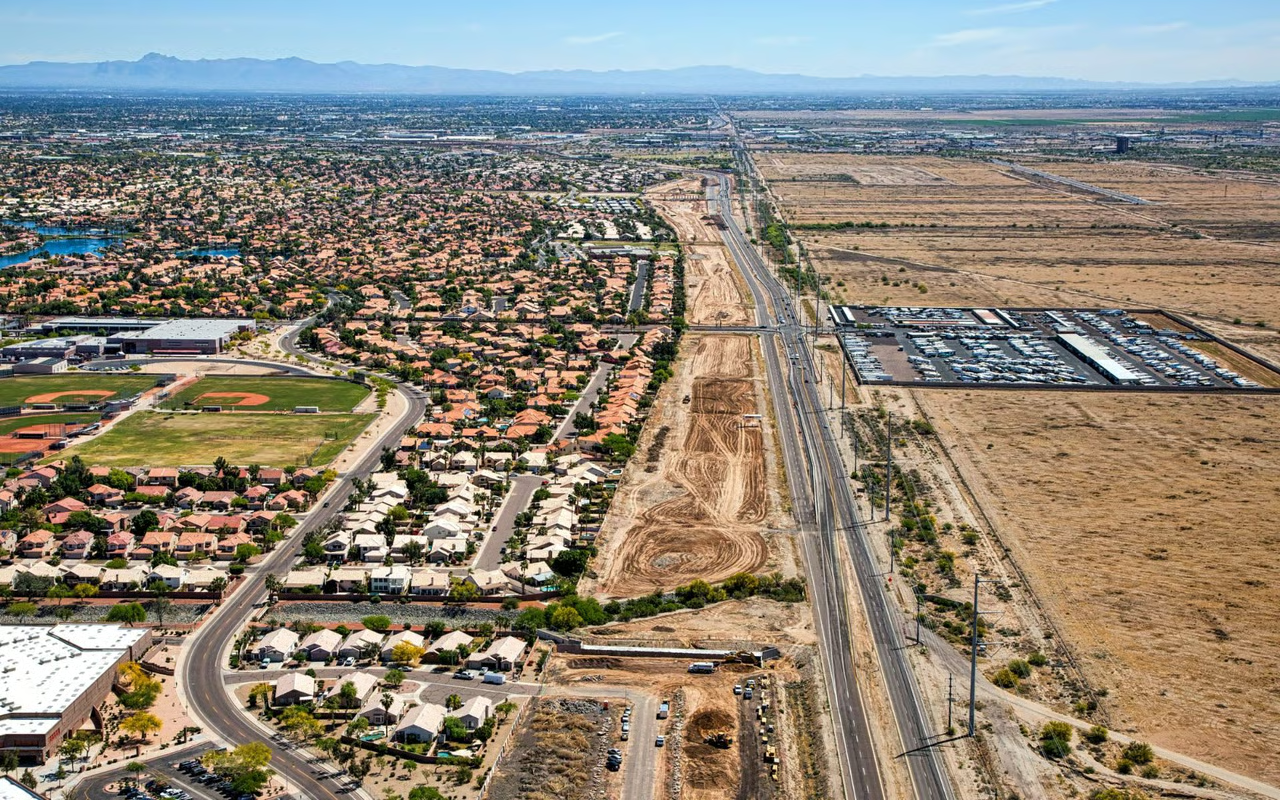
The Elliot Road Technology Corridor and the area around Falcon Field Airport carry Mesa's industrial and flex inventory — manufacturing, light assembly, and distribution buildings served by US 60, Loop 202, and Power Road access — alongside a growing base of multifamily near Downtown Mesa's light-rail extension and ASU's Polytechnic campus.
Building specs matter more here than in almost any other submarket in this exchange: clear height, dock-door count, power capacity, and column spacing determine whether a given building fits a specific investor's replacement criteria, and none of that is confirmed by a listing sheet alone.
Rent structures on Mesa industrial buildings tend to run triple-net with tenant-paid utilities and maintenance, which simplifies income verification compared to a gross-lease retail building, but the trade-off is that any deferred maintenance obligation the landlord retained needs to be identified explicitly rather than assumed to be the tenant's responsibility.
Multifamily And Downtown Redevelopment Alternatives
For investors who don't want industrial exposure, Downtown Mesa's ongoing redevelopment and the multifamily growth around the light-rail corridor offer a second track — smaller apartment buildings and mixed-use parcels with more straightforward underwriting than an industrial building's mechanical and power specs.
Running both tracks at once — industrial and multifamily — as parallel identification candidates keeps the exchange from depending on a single asset class clearing underwriting in time.
Downtown Mesa's redevelopment pipeline also means some multifamily and mixed-use parcels come with entitlement or construction-completion questions of their own, so a candidate still under construction gets a completion-date confirmation from the developer before it's treated as a serious contender rather than a placeholder on the list.
Building The Identification Slate Around Building Size And Power
A Mesa identification list should specify enough building detail that no candidate needs a second look mid-window:
- Industrial or flex building with confirmed clear height and power capacity
- Small multifamily property near the light-rail corridor
- Downtown Mesa mixed-use parcel
- Backup flex building near Falcon Field
Each candidate's spec sheet gets attached to the identification list itself, not held separately in a broker's email, so the lender, the advisor, and the qualified intermediary are all working from the same set of confirmed numbers rather than a verbal description of the building.
Phasing Lender Underwriting Against The 45-Day Window
Industrial and flex loans often require an environmental Phase I report that a straightforward retail or office loan does not, so that report gets ordered the day a Mesa industrial candidate is added to the list — not after it becomes the frontrunner — because Phase I turnaround alone can run two to three weeks.
The lender's underwriting schedule gets confirmed in writing against the 180-day close the same week identification happens, so a slow environmental report or a power-capacity verification doesn't become a surprise three weeks before the deadline.
The same phasing applies to the seller side when the investor is exiting a relinquished property concurrently — closing statement, payoff figures, and the qualified intermediary's transfer instructions get locked in on the same calendar as the Mesa purchase, so financing on one side doesn't stall because the other side's paperwork is still in progress.
Coordinating Seller Records With The Advisor's Tax Timeline
Mesa industrial and multifamily sellers are more likely than a small retail landlord to have full-year financial statements, capital expenditure logs, and a formal management report, and pulling all three the day a property is added to the list gives the investor's CPA a complete picture well before the exchange's tax reporting needs to be prepared.
That same package — financials, capex history, management report — becomes part of the permanent exchange file, so the reasoning behind choosing a Mesa property over another submarket is documented rather than left to memory.
Common 1031 Exchange Questions
Why does a Mesa industrial replacement take more lead time than a retail one?
Clear height, dock-door count, power capacity, and environmental Phase I review all need direct confirmation rather than a listing sheet, and the Phase I report alone can take two to three weeks — that work should start the day the property joins the identification list.
Is Downtown Mesa multifamily a realistic backup to industrial property?
Yes — running a small multifamily or mixed-use candidate near the light-rail corridor as a parallel track keeps the exchange from depending entirely on an industrial building's environmental and mechanical review clearing in time.
What building specs matter most for a Mesa flex-space exchange?
Clear height, column spacing, dock-door count, and confirmed power capacity are the specs that determine fit for most industrial buyers, and all four should be verified directly rather than taken from a marketing flyer.
How does Falcon Field affect Mesa's industrial stock?
The airport anchors a cluster of aviation-adjacent manufacturing and flex buildings nearby, which broadens the industrial identification pool beyond the Elliot Road corridor alone.
Does a Phase I environmental report affect the 180-day close?
It can if it's ordered late — since the report can take two to three weeks, it needs to start the same week the industrial property joins the identification list so the lender has a confirmed underwriting date well before day 180.